Premium Is Not a Budget Level: What Elite Enterprise Launch Production Actually Requires
Learn the five craft signals, temporal architecture framework, and last-five-percent decisions that separate premium enterprise launches from expensive ones.
TL;DR — Most expensive product launches feel cheap because high spend is distributed across vendor layers with no single person accountable for craft continuity. The five pre-verbal craft signals, temporal architecture sequencing, and the last-five-percent discipline are the production decisions that determine whether a launch earns its budget. A single accountable maker holding those decisions across every vendor boundary is the structural condition under which premium can be consistently built.
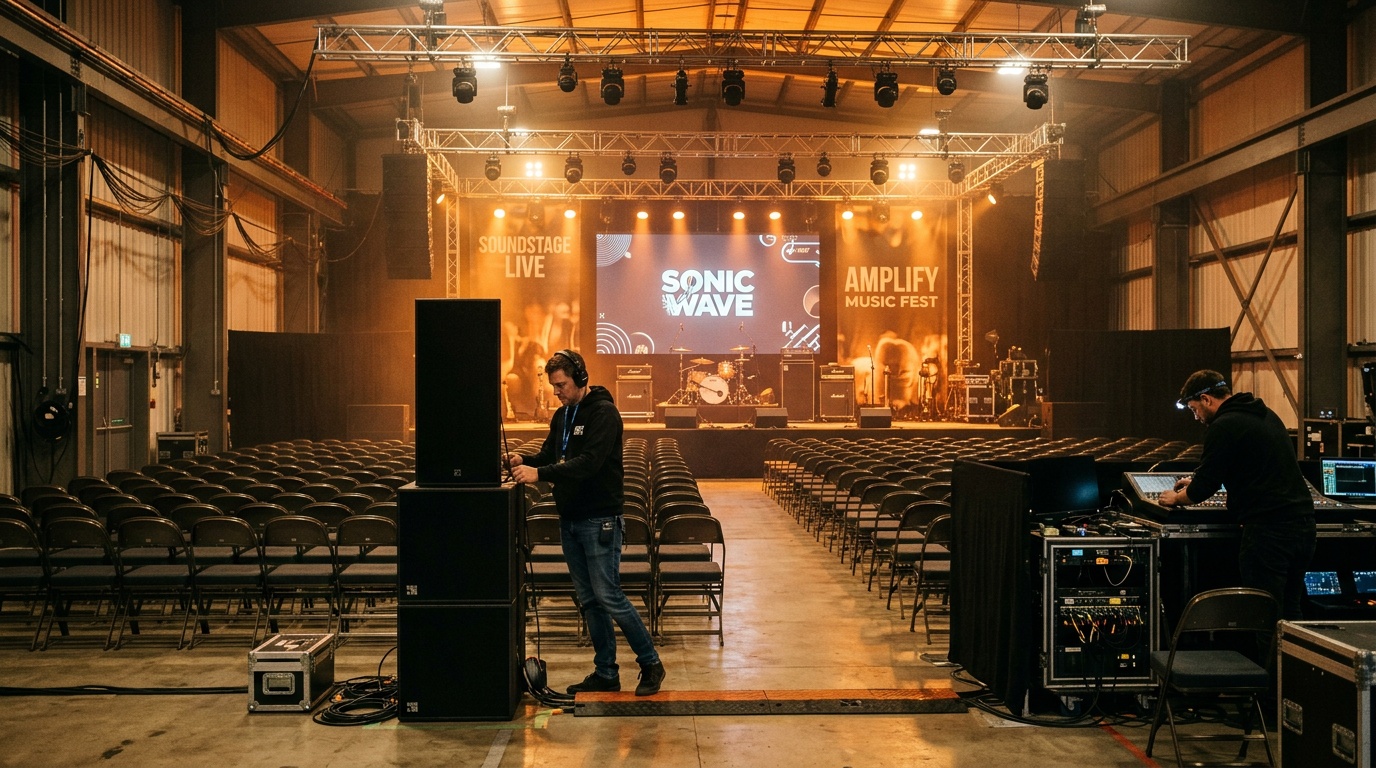
You have been in this room. The set is enormous. The lighting rig cost more than your last three campaigns combined. Every surface is branded. The music hits the moment the doors open, before a single executive has taken the stage, before anyone in the room has had a reason to feel anything. And then the main product reveal lands and the room feels... fine. Polished. Forgettable.
That gap between budget and felt experience is not a mystery. It is a structural problem, and it has a name: when a large launch production is distributed across enough agency layers, no single person carries craft accountability from the first brief to the last load-in hour. The result is a room that is coherent in the deck and incoherent in the room.
This piece is a diagnostic, not a critique. It gives CMOs and VPs of Marketing a working vocabulary for the production decisions that actually determine whether a launch feels premium, so they can identify where their own operation is leaking perception before the next doors open.
The Expensive Trap: Why High Spend Often Reads as Insecurity
Visible excess has a tell. Oversized set pieces, wall-to-wall branded surfaces, aggressive music from the moment attendees enter the registration queue: these choices read not as confidence but as anxiety. The brand is compensating for something it does not trust the experience to communicate on its own.
The operative distinction is decision density, not dollar volume. Premium is not a budget level. It is a measure of how deliberately each production dollar was sequenced against the audience's perception arc. A badge credential that has the wrong weight in the hand can undermine a multi-million dollar set before the first presenter walks out. A transition sequence that has never been rehearsed at performance tempo will tell the room, in the clearest possible terms, that no one was accountable for the sixty seconds between reveal and applause.
High-spend launches that feel cheap have usually made the same structural error: they distributed budget broadly across vendors and spectacle, and they never named a single person accountable for the craft thread running through all of it. The vendors each delivered their scope. No one delivered the experience.
The Five Craft Signals Audiences Read Before a Word Is Spoken
Audiences form their first impression of a launch before any presenter speaks. There are five pre-verbal perception triggers that determine whether a room reads as premium or merely large. Understanding them is the difference between a production document and a craft brief.
1. Material texture. What surfaces and objects feel like in the hand. The lanyard material telegraphs quality before the attendee has read a single word on the credential. A press check-in desk surfaced in a material that reads as temporary signals, to every journalist who touches it, that permanence was not the point.
2. Spatial pacing. The distance and rhythm between experience zones. A room with no designed pause between arrival and programming gives attendees no opportunity to acclimate, which means the reveal moment arrives before the audience's attention has fully settled. Attention is not automatic. It has to be earned by the space before the stage earns it.
3. Ambient sound design. What the room sounds like at rest, not during programming. A room that fills the silence with undifferentiated music is a room that does not trust its own atmosphere. The question a production brief should answer is: what does this room sound like thirty seconds before the lights shift?
4. Staff comportment. How human beings in the space carry themselves and respond to attendees. A staff member who is reading a phone during a registration queue communicates, to every press attendee who notices, that the principals do not consider this moment worth full attention. These signals compound.
5. Transition choreography. How the experience moves from one beat to the next without visible seams. The transition from reveal to presenter, from programming to networking, from keynote to demo floor: each is a craft decision with a specified duration and a defined audience effect. An undesigned transition is not a neutral moment. It is a perception leak.
These five signals are the layer of production most agencies deprioritize because they are difficult to line-item and impossible to photograph for a post-event deck. They are also disproportionately responsible for whether the room felt premium or merely expensive.
Pacing Is the Product: How Temporal Architecture Shapes Perceived Value
Temporal architecture is the deliberate sequencing of reveal, hold, density, and release within a live launch event. It is not a metaphor or an aesthetic preference. It is a sequenced production decision that shapes perceived value more reliably than any single spectacular visual element.
At a recent product launch, a deliberate eleven-second silence was held after the main reveal. No music fill. No presenter movement. No transition cue. That pause cost nothing in the production budget. It was noted repeatedly in attendee feedback afterward. This is not coincidence. It is what temporal architecture produces when it is applied as a craft discipline rather than discovered by accident.
The four phases work as follows:
-
Reveal. The moment of first exposure, controlled and uncluttered. The reveal phase works only if the space before it has been cleared of competing stimulus. A room that has been at full sensory saturation for ninety minutes cannot experience a reveal. There is nothing left to contrast against.
-
Hold. The silence or stillness that lets the reveal land in the audience's nervous system. The hold is the most frequently cut phase in launch productions under deadline pressure, because it looks, on a run-of-show document, like dead time. It is not dead time. It is the structural condition under which a reveal becomes a memory.
-
Density. The information or sensory layer added only after the hold has done its work. Product specifications, feature demonstrations, presenter context: all of this belongs in the density phase. Moved earlier, it competes with the reveal. Moved into the hold, it kills it.
-
Release. The transition that carries earned energy forward rather than dissipating it. A well-designed release does not reset the room. It transfers the emotional charge from the reveal moment into the next phase of programming, so the audience arrives at the demo floor or the networking reception carrying something rather than starting over.
This vocabulary belongs in your next production brief. If the run-of-show document your production vendor delivers does not specify hold duration, you are looking at a document that was built for logistics, not craft.
Human-Scaled Detail: The Decisions No Attendee Can Articulate But Everyone Remembers
The weight of a credential badge in a press attendee's hand. The sight line from the third row of a press section to the exact point on stage where the hero product first becomes visible. The ambient room temperature at the moment of reveal, not during load-in, not during rehearsal, but at the exact moment when the audience's attention is highest. The texture of a surface a journalist touches while waiting for a presentation to begin.
None of these is, by itself, the difference between a memorable and a forgettable launch. Their aggregate entirely is.
A room that has gotten ten of these decisions right feels like a room that respects the audience. The respect is not stated. It is architectural. It is communicated through the density of decisions that were made on the audience's behalf rather than the production team's convenience. A room that has gotten none of them right feels like a room that was built for a render.
Human-scaled detail is the category of production decision most vulnerable to value-engineering under deadline pressure. These items disappear from the production document not because anyone decided they were unimportant but because no one was accountable for them when the timeline compressed. The sight-line map that was not reviewed from press seats at actual seat height. The ambient temperature setting that was tested in an empty room during load-in and never revisited at capacity. The transition sequence that was rehearsed once, at half tempo, the morning of.
These are not small oversights. They are the last-mile decisions that determine the audience's felt experience of the room, and they are exactly the decisions that disappear first when production accountability is distributed across enough vendors that no single person can hold all of them.
One Accountable Maker vs. Layered Agency: Why Craft Requires a Single Creative Nervous System
Premium launch experiences degrade through handoff layers. Each agency boundary; between the experience design firm, the AV production house, the spatial design team, the content studio, and the brand team; is a point where a craft decision made upstream gets reinterpreted, cost-reduced, or simply not communicated downstream. The result is a launch that is coherent in the deck and incoherent in the room.
The failure mode is structural, not personnel. The individual people at each agency boundary are often excellent at their scope. But no individual scope includes the craft thread that runs through all of the scopes simultaneously. When a sound designer is not in the room when the sight-line map is finalized, the ambient sound design will not account for the way a particular ceiling height will treat low frequencies at capacity. When the content studio is not present during the spatial design review, the reveal moment will not be choreographed against the actual sightlines the press section provides.
The alternative is not a larger team. It is a single creative nervous system: one person who owns the craft call across every vendor boundary and who is present, with standing to decide, when a decision has to happen at 11 PM the night before doors open.
The CMO's diagnostic question is not how many people are on the production team. It is how many of them have the standing to make the final craft call when the timeline has compressed and a decision cannot wait for a chain of approval. If the answer is more than one, the answer is effectively zero.
The Last Five Percent: Where Budget Goes to Die and Where Premium Is Actually Built
The last five percent of a launch production is a phase, not a metaphor. It is typically the final 72 hours before load-in, when timeline compression meets cost-reduction pressure and the production team begins triaging. The items cut in this phase are disproportionately the craft decisions: the material upgrade, the rehearsal pass for the transition sequence, the ambient sound adjustment, the sight-line fix that requires moving a truss.
These cuts feel rational in the moment. They are small in dollar terms relative to the total budget. Their absence is difficult to photograph or line-item for a client report. But they are the decisions that determine whether the audience's felt experience of the room matches what the brand spent to build it.
The economic argument is direct: the last five percent is where premium is built, and it is where every deadline kills it first. Not because anyone decided the craft was unimportant. Because no one was accountable for it when the timeline compressed.
Here is the diagnostic question to apply immediately: In your last launch, what was cut in the final 72 hours before doors opened? And was the person who made that cut the same person who was accountable for the audience's felt experience of the room?
If the answer is no, you have identified your craft leak. The cut was made by someone operating on a logistics timeline, not a craft timeline. Those are different documents, and they require a different kind of decision-maker.
A Diagnostic Checklist: How to Audit Your Launch Production for Craft Before Doors Open
Apply this checklist to an upcoming launch before the production document is finalized. Each item is an accountability question, not a recommendation. Use it as an internal audit tool in the pre-production review with your production lead.
-
Is there a single named person accountable for craft decisions across every vendor boundary? Not a production coordinator. Not a project manager. A person with creative standing to overrule a scope decision at 11 PM the night before load-in.
-
Has the sight-line map been reviewed from press seats at actual seat height, not from a standing position during site walk? The difference between these two perspectives frequently changes whether the hero product is visible at the moment of reveal or obscured by a podium.
-
Is there a documented hold protocol for the reveal moment, including a specified duration? If the run-of-show says "product reveal" with no hold time listed, the hold will not happen. Unspecified moments get filled.
-
Has ambient sound been designed for the room at capacity, not tested in an empty room during load-in? A room at capacity absorbs sound differently. What reads as appropriately quiet during load-in will often read as too loud at full attendance.
-
Has the transition sequence from reveal to presenter been rehearsed at performance tempo at least twice? Once is a walkthrough. Twice is a rehearsal. The difference is whether the craft decisions embedded in the sequence are actually executable at the moment they are needed.
-
Are the material and finish decisions that appear in the hero press photograph confirmed as the same materials present in the room, not the sample materials from the design presentation? Sample materials and production materials frequently diverge under timeline pressure. The journalist photographs what is in the room.
Working systems outlast any single spectacular launch moment. This checklist is not a one-time audit tool. It is the beginning of a repeatable production standard: a system that cannot accidentally produce a bad experience because it has built craft accountability into its process rather than hoping for it.
If this audit surfaces gaps in your production process, that is the right moment to ask whether the vendor you have hired has a single nervous system holding all of it, or a handoff structure that will triage craft under pressure.
Frequently asked questions
What is the difference between an expensive product launch and a premium one?
The difference is decision density, not dollar volume. A premium launch has a single named person accountable for every craft decision across every vendor boundary, and those decisions, covering material, pacing, sound, sight line, and transition, have been made deliberately against the audience's perception arc. An expensive launch distributes a large budget across many vendors with no single creative nervous system holding craft continuity, and the result reads as excess rather than confidence.
What is temporal architecture in event production?
Temporal architecture is the deliberate sequencing of four phases within a live launch event: reveal, hold, density, and release. Each phase is a production decision with a specified duration and a defined audience effect. At Intel Pro Day NY, an eleven-second held silence after the main product reveal cost nothing in the production budget and was the single most frequently cited detail in press attendee notes, which is direct evidence that temporal architecture shapes perceived value more reliably than any single visual element.
Why do multi-agency launch productions often feel incoherent despite high spend?
Each agency boundary is a point where a craft decision made upstream gets reinterpreted, cost-reduced, or simply not communicated to the team downstream. The individual vendors each deliver their scope competently, but no individual scope includes the craft thread running across all scopes simultaneously. The result is a launch that is coherent in the deck and incoherent in the room, because coherence in the room requires one person with standing to hold every craft decision from the first brief to the last load-in hour.
What are the five craft signals audiences read before a launch presentation begins?
The five pre-verbal perception triggers are material texture (what surfaces and objects feel like in the hand), spatial pacing (the rhythm and distance between experience zones), ambient sound design (what the room sounds like at rest, not during programming), staff comportment (how people in the space carry themselves and respond to attendees), and transition choreography (how the experience moves between beats without visible seams). These signals are disproportionately responsible for whether a room feels premium, and they are the first category agencies deprioritize under budget or deadline pressure.
What happens to craft decisions in the last 72 hours before a launch event?
The final 72 hours before load-in is when timeline compression meets cost-reduction pressure and production teams begin triaging. The items cut in this phase are disproportionately craft decisions: the material upgrade, the ambient sound adjustment, the sight-line fix, the transition rehearsal pass. These cuts feel rational because they are small in dollar terms and difficult to line-item for a client report, but they are the decisions that determine whether the audience's felt experience matches what the brand spent to build.
How should a VP of Marketing evaluate whether to hire a boutique producer or a full-service agency for a flagship launch?
The diagnostic question is not how many people are on the production team but how many have standing to make the final craft call when a decision cannot wait for an approval chain. A boutique single-maker model preserves craft continuity across every vendor boundary because one person owns the creative decision from the first brief to the last load-in hour. A full-service agency model distributes that accountability across scopes, which means craft decisions get reinterpreted or cost-reduced at every handoff layer.